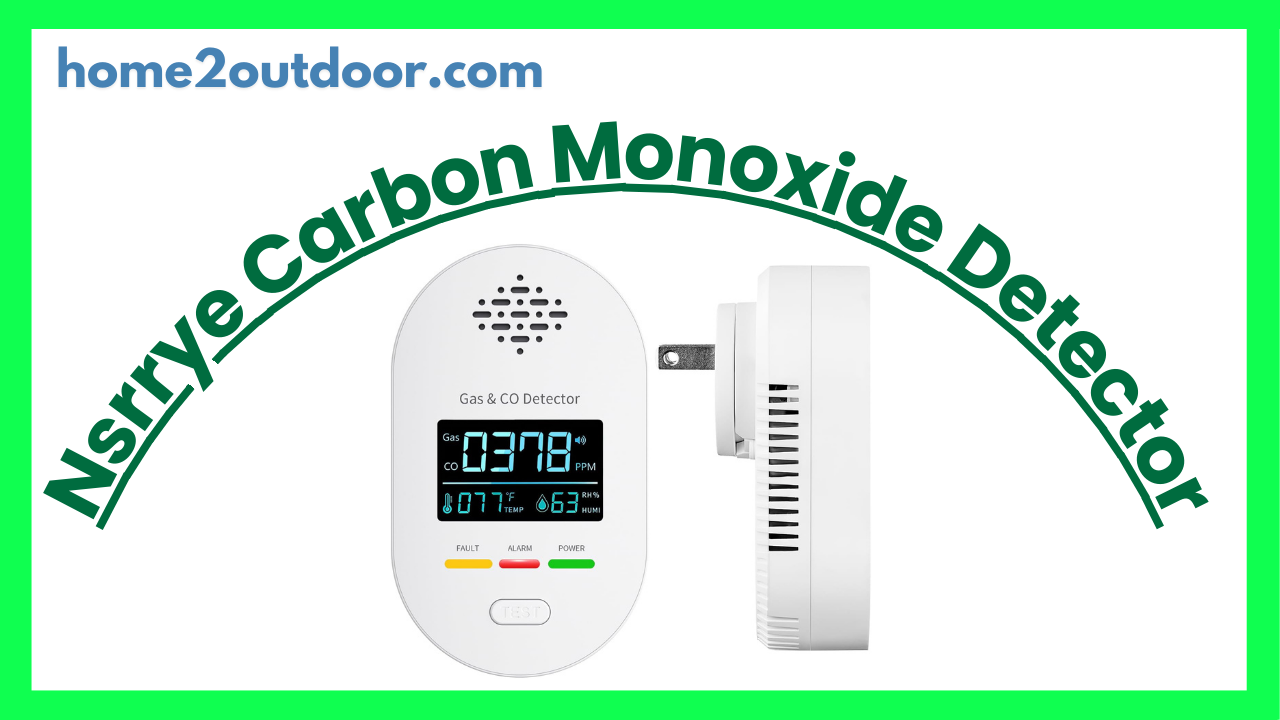
Here’s what I was able to piece together about the Nsrrye 4‑in‑1 / Plug‑in CO and Natural Gas Detector (also “Combination Gas & Carbon Monoxide Detector, with Temperature & Humidity Display”), and some cautions. The product is sold under that name by Shenzhen Cinyue Electronic Technology Co., Ltd.
What It Is / What the Features Are
Based on the listing(s), here are the main features:
| Feature | What the listing says / implies |
|---|---|
| Brand / Model / Style | Nsrrye; marketed as “Portable Travel Carbon Monoxide Detector ‑ Plug in CO and Natural Gas Detector / 4‑in‑1”. |
| Power Source | Corded electric (plug‑in) – needs to be plugged into an AC outlet. It says “no batteries required”. |
| Physical Size / Material | Dimensions approximately 2.56″ × 2.56″ × 4.53″ (about 65 x 65 x 115 mm). Material ABS plastic. |
| Detected Hazards / Sensors | • Carbon Monoxide (CO) detection • Natural / combustible gas detection (e.g. methane, LPG etc.) • Also measures temperature and humidity (so that you get environmental monitoring in addition to gas alarms) |
| Display / Indicators | It has some visual display (digital or LED) showing temperature and humidity; plus probably gas concentration / status. There is “visual alarm”. |
| Alarm / Alert | Audible + visual alarm when hazard levels are exceeded. Probably volume ~85 dB (common in similar products, though this exact model’s loudness isn’t clearly specified). |
| Voltage Compatibility | AC input (often in the range 90‑240V in similar plug‑in gas/CO detectors). The Nsrrye listing shows “Power Source: Corded Electric” but doesn’t explicitly list the voltage in the snippet I saw. |
| Application / Use | Suitable for homes, travel, hotels etc. Because it’s plug‑in, it’s more usable in places where wall sockets are accessible. Travel use is claimed. |
What Is Not Clear / What to Be Careful About
Because this seems to be a relatively generic or less‑known brand, some important info is missing or not fully verified, so there are risks. Here are what I found lacking, plus what to check if you consider buying:
| Unclear / Possible Weakness | Why It Matters |
|---|---|
| Certifications / Safety Standards | The listing does not clearly state whether it complies with recognized safety or certification standards (e.g. UL 2034 for CO alarms, EN 50291, etc.). Without this, the reliability of sensor thresholds, alarm timing, and safety under different conditions is uncertain. |
| Alarm Thresholds & Response Times | It’s not clear exactly at what CO concentrations (parts per million) and how fast the alarm triggers. Standards require certain time‑limits for certain PPM levels. Without knowing this, you may get late warnings. |
| Backup in Power Outage | There is no battery backup according to “no batteries required” in the listing. If power goes out, the detector may become non‑functional. That’s a significant limitation if you want continuous safety. |
| Long‑Term Reliability / Sensor Lifespan | No detailed info on how long the sensor remains accurate (e.g. in years), whether there is drift, whether replacement parts or service is available. |
| Audibility Clarity | While it likely has an audible alarm, the actual decibel level, whether the sound is loud enough in a noisy home or through walls, etc., is not clearly specified. |
| False Alarm Risk | With multiple gases (CO + combustible gases) plus environmental sensors, there is potential for false or nuisance alarms unless the sensor calibration and thresholds are good. Especially with generic sensors, sensitivity vs false positive trade‑off can be problematic. |
| Display Accuracy & Environmental Limitations | Temperature and humidity sensors may be “nice to have” but their accuracy may be approximate. Also, high humidity, dust, or harsh temperatures can degrade performance. |
How It Compares to More Established / Higher‑End Detectors
To give you some idea of what you might expect versus more premium safety devices:
- Premium CO detectors often provide certified performance (UL, EN etc.), so you know their thresholds and response times have been tested. They may have sealed 10‑year batteries, or backup power.
- Better models sometimes show peak value memory, so you can see what was the highest CO level since last check.
- Loud alarms, voice alerts, tamper detection, etc., are features of higher‑cost models.
- Lower latency, quicker responses in dangerous CO level spikes are more assured in well‑certified designs.
My Assessment
If I were evaluating this Nsrrye detector for use in a home in Dhaka (or somewhere with similar conditions), here’s what I think:
- It potentially offers good value for basic monitoring of CO and natural gas plus temp/humidity, if it works as advertised. For many users, the combination of sensors is useful: seeing environment conditions helps (e.g. humidity or temp issues).
- The plug‑in nature makes it easy to deploy, but the lack of battery backup is a concern—power outages happen, and you may lose protection when lighting/fire/warmth issues might also occur.
- Because certification is not clear, I would treat it as a “first line” device—not something to rely on exclusively for safety, especially in more hazardous settings. I’d probably pair it with another known detector, or ensure that the gas appliances, ventilation, etc., are well maintained so risk is minimized.