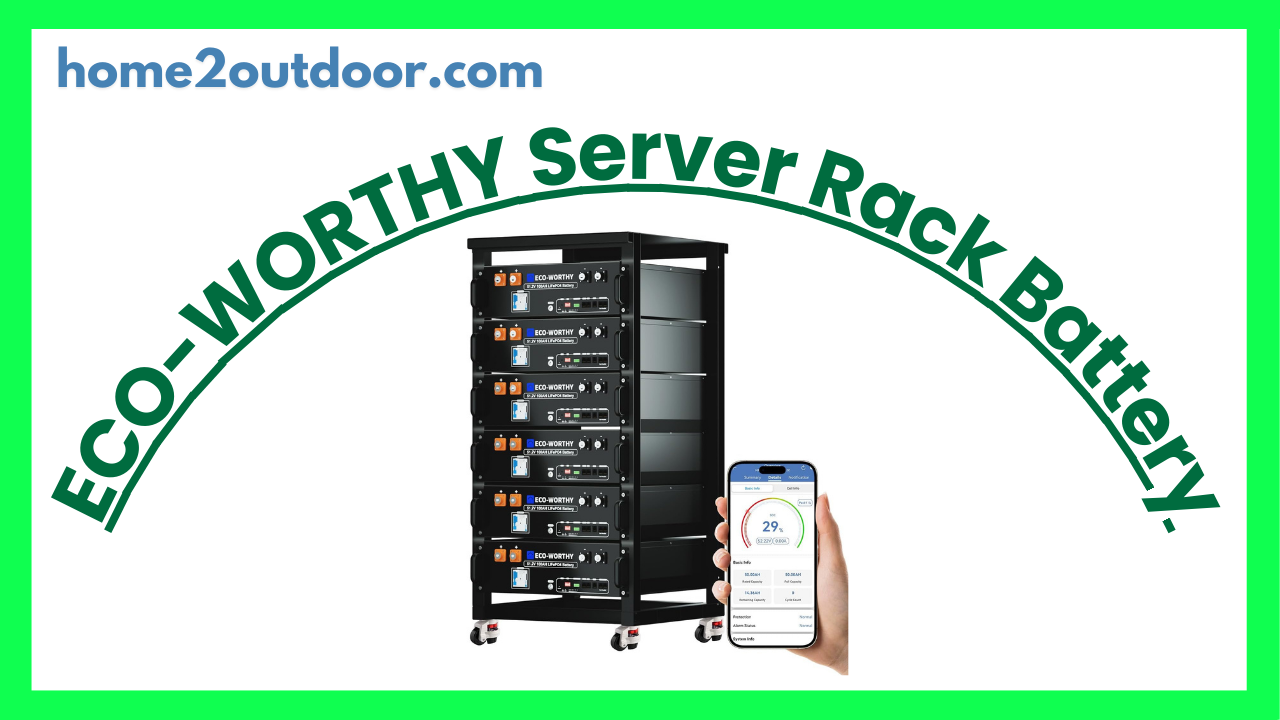
Here’s a detailed, balanced review of the ECO‐WORTHY 48 V 600 Ah Server Rack LiFePO₄ battery pack (or more precisely a 6‑pack of ECO‑WORTHY’s 48 V 100 Ah server rack modules, totaling ~30.72 kWh). It covers what it does well, its trade‑offs, and who it’s best suited for.
What Is It
What we’re discussing is essentially six of the ECO‑WORTHY 48 V 100 Ah LiFePO₄ server rack battery modules used together (6 × 100Ah at 51.2V nominal) to produce a battery bank of about 30.72 kWh.
Important features include:
- Rack‑mountable server‑rack form factor (3U modules) with all‐metal housing.
- Built‑in BMS (Battery Management System), supporting protections (over/under voltage, etc.), with both Bluetooth & WiFi monitoring (and in some cases CAN/RS485 communication for larger/hybrid systems).
- Expandability: supports parallel connections of multiple modules. Up to “32 units in parallel” is mentioned in product listings for the 100Ah module version.
What Works Well (Strengths)
- High Energy / Good Value
~$800–$900 (or promotional prices) gets you a ~5.1 kWh unit in the 100Ah module, meaning the 6‑pack (~30.7 kWh) gives pretty high energy for a lower‑cost LiFePO₄ setup compared to many premium brands. Users and reviews emphasize its cost‑effectiveness. - Scalability & Modularity
Because of the rack format, metal case, and parallel/communication features, you can scale up gradually. If your energy demands grow, you can add more modules. - Decent Build & Design
- The all‑metal housing is robust.
- The layout internally is reasonably clean, with attention to cell spacing for cooling.
- Terminal layout and ease of wiring gets positive notes from users.
- Monitoring Features
The Bluetooth/WiFi app monitoring, state‑of‑charge, temperature, voltage etc., are helpful. While not ultra‑premium, they give enough visibility for most home/off‑grid / backup users. - LiFePO₄ Chemistry Advantages
Long cycle life, safer chemistry (less thermal runaway risk), good performance under moderate conditions. Users trust that this will deliver many years if cared for properly.
What’s Less Good / Weaknesses & Limitations
- Weight & Handling
Each module is heavy (~95 lb per 100Ah module) and, depending on how many you have, moving/installing them can be laborious. Some units lack handles or make handling difficult. - Cold‑Temperature Performance / BMS Behavior
- In testing, units sometimes fail to enforce a cutoff at low temperatures, meaning the battery still discharges when cold—this may be harmful long‑term.
- Also some reports that the temperature monitoring or protections (as claimed) are weaker or less precise than expected.
- Certification / Standards
Some users note that the battery lacks certain international safety certifications (e.g. UL listings) which may matter depending on local laws or insurance. That can also impact resale or import. - Support & Customer Service
Mixed feedback: some users report delays, difficulty reaching Eco‑Worthy, or issues getting a prompt resolution. - “Missing bells & whistles”
- No built‑in screen/display on the battery itself (some users expect that).
- The app/software is functional but not ultra polished; some minor glitches in setup or monitoring.
- Real vs. Advertised Cycle Life Under Stress
While the advertised cycles (e.g. 6,000 cycles at 80% DoD or even more) are good, real usage (heat, discharge depth, environmental factors) will likely reduce that. Some users warn against taking spec numbers too literally.
How It Performs in Practice
From user tests / independent reviews:
- The modules seem to hit close to their rated capacity in many cases, though maybe slightly below in very cold or high‑load (surge) conditions.
- Surge handling is acceptable. Some over‑rating for spikes; the system tolerates surges above its rated continuous discharge for short periods, though that could stress the system if repeated often.
- Long‑term stability seems reasonable in benign climates; less tested (or less reported) in very hot or very cold climates.
Fit for Use (Best Use Cases & When It Might Be Overkill or Not Suitable)
Good Fit For:
- Off‑grid homes, workshops, cabins etc., where you need substantial usable energy storage and have the space / are okay with heavier installation.
- Situations where cost per kWh is important, and you are willing to trade off some premium features for lower price.
- Users who will monitor carefully, install properly (cooling, wiring, protection), and treat the battery well (avoid extremes of temperature, avoid deep discharges frequently).
- Backup power systems where keeping some circuits running (lights, fridge, electronics) for many hours or overnight is needed.
Less Good For:
- Critical installations where certification (UL, local safety) is essential (e.g. certain commercial installations with regulatory oversight).
- Cold climates where battery will get exposed below freezing often without heating or environmental control — because protection at low temp seems less reliable or not well enforced.
- Situations where frequent or rapid surges are common or loads are unpredictable without buffer for stress.
- If you need plug‑and‑play with a large, polished UI/display, high‑end firmware, etc., you may find this a bit basic.
Overall Verdict
ECO‑WORTHY’s 48 V 600 Ah server rack LiFePO₄ setup gives very strong value for the price. It’s a serious contender for people building large battery banks without huge budgets, especially for backup, off-grid, or solar energy storage.
You’ll get a lot of energy per dollar. But to realize that value, you’ll need to pay attention to installation (cooling, layout), treat the battery well (avoid extreme temperatures, avoid overloading BMS, avoid very deep discharge regularly), and accept that you’re trading off premium bells and whistles, possibly slower or less responsive support, and less rigorous certification in some cases.