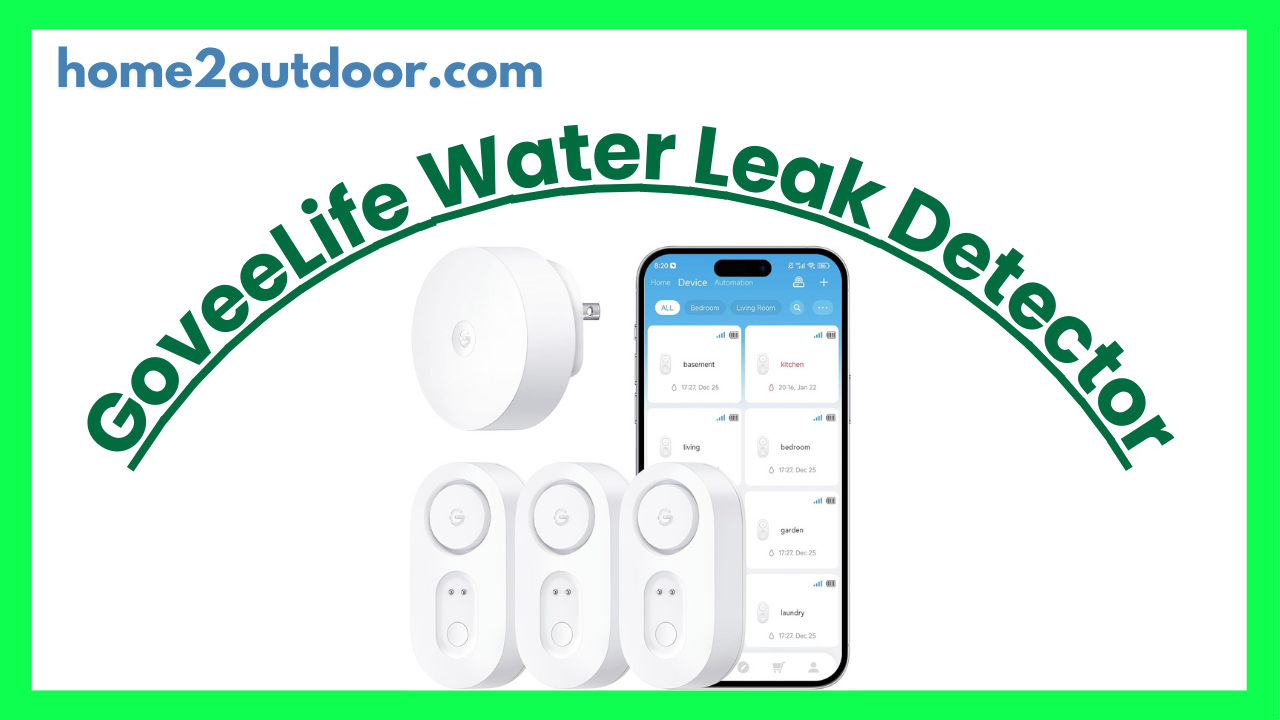
Here’s a detailed look at the GoveeLife Upgraded Smart Water Leak Detector “1s”: what it does, its strengths & weaknesses, and things to watch out for. If you want, I can try to check how suitable it is for use in Dhaka (voltage, availability, etc.).
What It Is
The GoveeLife Upgraded Smart Water Leak Detector 1s is a wireless sensor + gateway system meant to detect water leaks early and notify you. It combines a local alarm with remote alerts (via app, SMS/email) so you can respond even if you’re not physically at the spot. It is part of Govee’s smart‑home safety/sensor lineup.
Key Features & Specs
Here are its main features / technical specifications based on what I found:
| Feature | Details |
|---|---|
| Detection Speed | Detects water quickly (contact with sensor probes). According to the manual, detection within ~2 seconds once water touches the probes. |
| Alarm | Local audible alarm of 105 dB, plus flashing red LED when water is detected. |
| Remote Alerts | Sends notifications via the GoveeLife (or GoveeHome) app, plus email, SMS. |
| Range / Wireless | Claims “Ultra‑Long Range” of ~1804 ft (≈ 550 m), via “Sub‑1G technology” through about 5 walls when used with its gateway and compatible sensors. |
| Waterproof Rating | IP67 rating, so the sensor body can handle water splashes, humidity, possibly temporary submersion. |
| Battery Life | About 5 years on a single battery (sensor) under normal usage. (Gateway/mains device may use external power) |
| WiFi/Gateway Requirements | The system requires a gateway (for sensors that are not standalone). The sensors are paired to a gateway/hub. The system works over 2.4 GHz WiFi networks. |
| Adjustable Volume / Alarm Controls | The alarm volume can be adjusted in 4 levels via the app — you can choose a loud alarm for daytime / high alert, quieter modes for night, or even mute/turn off the local alarm (while keep remote alerts active). |
| Other Features | “Find device” feature in the app (makes sensor beep so you can locate it), app push notifications, email/SMS to multiple recipients if set up. |
Pros / What’s Good About It
Here are what users and reviews tend to praise:
- Early warning: Because it sends out remote alerts (SMS/email/app) + loud local alarm, you can often catch leaks early.
- Good loudness: 105 dB is loud — should wake people or alert even if you’re in another room.
- Long battery life: 5 years is good for battery sensors; less maintenance.
- Range: The large wireless range through walls is helpful for larger homes or detecting leaks in remote areas (basements, sheds, laundry rooms).
- Durability: IP67 makes it robust in damp/wet environments. Better than just splash‑proof.
- Adjustability: Having volume control / mute / app control is helpful if you want to avoid disturbing noise during quiet hours.
Limitations / What to Watch Out For
However, there are trade‑offs and possible downsides:
- Dependency on Gateway / Hub: If the gateway or the WiFi is down, remote alerts may fail. Local detection still works, but you might miss notifications if not on site.
- Battery & Replacements: While 5 years is long, after that battery replacement will be needed. If battery dies, sensor won’t work; need to monitor battery level via app.
- Alarm Visibility vs Coverage: Even though the range is long, walls and building structures reduce signal strength. Real‑life performance might be weaker than spec.
- False / Nuisance Alarms: Any wetness (condensation, spills, humidity) that contacts probes can trigger alarms. Might require careful placement.
- Volume may still be too loud or disruptive: Even though quieter modes exist, 105 dB is very loud; if in bedroom etc, even silent mode alerts may need attention.
- Power Requirements / WiFi Requirements: WiFi connection (2.4 GHz) is needed for remote alerts; if your router or network is only 5 GHz or unstable, setup may be tricky.
- Cost of Gateway + Sensors: If you need multiple sensors + gateway, cost adds up. Also, replacing sensors over time (if battery fails) is additional cost.
- Notifications Delay / Reliance on Internet: Remote alerts (SMS/email/app) may depend on internet and server availability; possible delays or failures if internet is down.
Practical Use Tips
If you use this, here are some suggestions to get the most from it:
- Place sensors in highest risk areas: under sinks, near washing machines/dishwashers, water heater base pans, behind toilets, along pipe clusters.
- Ensure sensors’ probes are exposed properly: probes need to contact water; if placed on an uneven surface or not flush, detection may be delayed.
- Use the volume settings to adjust so as not to wake everyone at night, but still loud enough during day / when you’re away.
- Test the alarm occasionally to confirm battery/gateway is functional.
- Monitor battery status via app; replace sensor/gateway if battery low (if possible).
- For remote alert reliability, ensure your WiFi is stable, gateway is plugged into reliable power, maybe on UPS if frequent power outages.
- If possible, integrate with other home alert systems or automations (e.g. smart water valve shut‑off, if available) so that in case of leak, water flow can be shut automatically.
Verdict / Summary
The GoveeLife Upgraded Smart Water Leak Detector 1s is a solid smart leak detection solution with a good set of features: long range, loud alarm, remote alerts, and decent durability. For most homes, it gives good protection against water damage, especially in places where leaks or floods could be expensive (basements, laundry rooms, etc.).