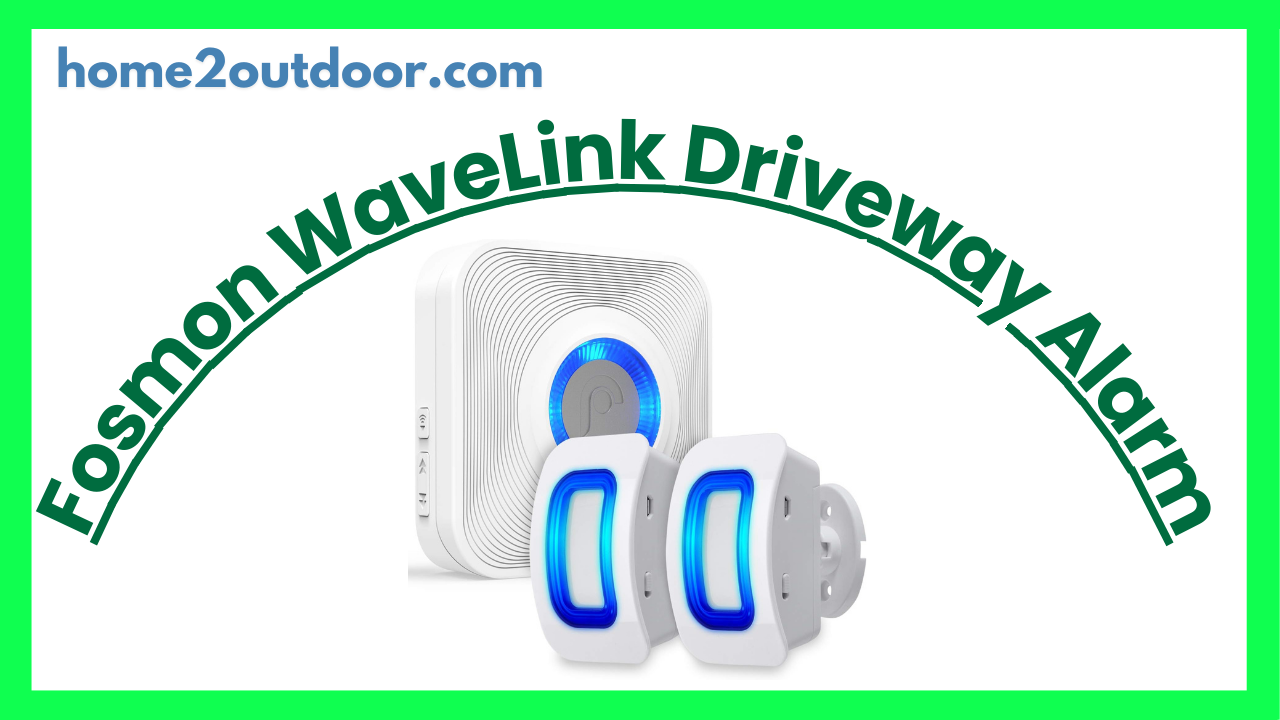
Here’s a detailed breakdown of the Fosmon WaveLink Door Chime / Driveway Alarm (sometimes listed as a “Door Chime Driveway Alarm Guard Wireless Motion Sensor / Motion Detector + Receiver” unit) — what it offers, its strengths & limitations, and things to watch out for. If you tell me what model you have (or are looking at) I can compare more precisely for your situation.
What It Is
This is a wireless motion‑sensor alarm / door chime system from Fosmon under their “WaveLink” series. It combines a motion detection transmitter (sensor) and a receiver (plug‑in), to alert you (via sound + LED) when motion is detected near a door, driveway, gate, or other entrance. It’s often used as a driveway alarm, store front alert, home entry alert, etc.
Key Features & Specifications
Here are its main specs & what it claims to do. These are drawn from product descriptions across several of the WaveLink models.
| Feature | Details |
|---|---|
| Motion Detection Range / Angle | Detects motion up to about 16.4 ft (5 m) out, with ~110° detection angle. |
| Wireless Range (Sensor → Receiver) | Up to 500 ft (~150 m) in an open‑area / line‑of‑sight setting. |
| Sound / Chime Options | Many tunes / ringtones: 58 unique chimes in many versions. |
| Volume Levels | Multiple settings: often 5 volume levels (including mute). Maximum volume ~110 dB. |
| Power for Receiver | The receiver plugs into AC mains (110V in many specs). |
| Power / Battery for Sensor | Sensor uses AAA alkaline batteries (1.5V) often. |
| LED Indicators | Both the receiver and the sensor (or transmitter) have LED indicators to give visual cues when activated (helpful for hearing impaired etc.). |
| Compatibility / Expandability | In the WaveLink line, you can pair multiple transmitters / sensors with one receiver (and vice versa) depending on model. Usually up to 10 sensors / transmitters. |
| Operating Conditions | Temperature range approx −15 °C to +60 °C (5°F to 140°F) in many specs. |
What It’s Good For / Strengths
- Long‑range wireless signal: The claimed 500 ft / 150 m range is useful for large properties, gates, driveway entrances far from the house.
- Customizable chimes & volume: If you want to differentiate alerts or have milder / louder settings, this flexibility helps.
- Easy installation: No major wiring; receivers just plug in, sensors are battery‑powered and mountable with included hardware.
- Visual alert: LED indicators are good for hearing‑impaired users, or if you want non‑audible cues.
- Scalable / Expandable: You can add more sensors if you want to monitor more than one entrance or driveway.
Limitations & What to Watch Out For
- Specified range vs real‑world conditions: While 500 ft is possible in open fields, buildings, walls, trees, hills etc. will reduce the effective range. Expect less in dense or obstructed environments.
- Battery life of sensor: With frequent motion or triggers, battery will drain. Many units use AAA batteries, so regular replacement needed.
- Power dependency of receiver: Since receiver is AC‑powered, power outages or lack of AC sockets in ideal positions could be a problem. If no backup power, alerts may be missed.
- False alarms / sensitivity: Pets, leaves, small animals, or moving objects can trigger the motion sensor depending on how sensitive it is and how well placed. Careful positioning helps.
- Indoor vs outdoor durability: Depending on the model, sensors may not be fully weatherproof. If placing outdoor or exposed to rain/sun/humidity, verify the build quality. Some models intended more for sheltered doorways, gates, not fully exposed outdoors.
- Sound loudness: The maximum volume (~110 dB) is loud; inside houses this could be very loud/disturbing depending on where the receiver is plugged and how insulated walls are. May need to adjust volume settings suitably.
Use Cases
This kind of device is suited for:
- Monitoring driveways / gates where someone approaching should trigger an alert.
- Business or shop entrances (deliveries, customers).
- Homes where you want to know if someone (or something) passes a threshold (e.g. gate) before they reach the door.
- Applications where you want non‑smartphone, non‑camera alerts (just a sound + maybe LED) and something relatively simple.
Things to Check / Best Practices
If you decide to buy or set one up, here are useful tips:
- Test the signal strength between the sensor location and the receiver location before final mounting, to check if the range / obstructions allow reliable detection.
- Place the sensor at a height & angle that minimizes false triggers (avoid sun glare, moving trees, small animals, vehicle headlights etc.).
- Use a location where the receiver’s sound can be heard; maybe multiple receivers in large homes.
- Keep spare batteries for the sensors, check battery status / low battery alerts.
- If installing outdoors or in a partially exposed spot, ensure the sensor is sheltered or sealed, and preferably choose a model with better weather resistance.
- Use the volume settings to adjust so the alert is noticeable but not disruptive (especially at night).